Blog
Sep. 01, 2026
Choosing the correct packaging film, forming depth, and pack format is one of the most important decisions when investing in Meat Packaging Machines. At Yijianuo, we recommend a structured process: first define the meat product and target shelf life, then calculate the required forming depth, select a compatible barrier film, choose the pack format, and finally validate sealing, vacuum, gas flushing, and machine performance through documented testing. This approach helps beginners avoid basic compatibility mistakes while giving experienced processors a practical framework for improving throughput, material efficiency, food safety, and presentation.
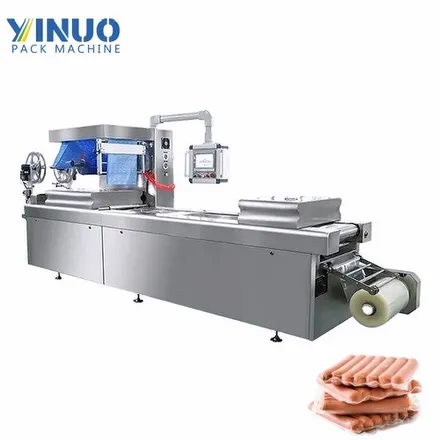
A packaging specification is not simply a choice between “thin film” and “thick film.” Film structure, thermoforming depth, sealing geometry, product shape, and machine configuration work as one system.
For example, a deep-drawn tray for bone-in lamb requires different material performance from a shallow tray for sliced ham. If the film is too rigid, it may bridge across corners or develop stress whitening. If it is too soft, the cavity may deform, the seal area may wrinkle, or the package may collapse during distribution.
The correct specification should balance:
Our recommended workflow is to treat meat vacuum packaging equipment as a complete packaging cell rather than a standalone machine. The lower web, upper lidding film, forming station, vacuum or MAP system, sealing station, cutting unit, and coding system must all be matched.
Before selecting a film or pack format, we first identify the physical and commercial characteristics of the product.
Record the following information:
Product category
Product geometry
Surface condition
Distribution environment
Commercial objective
This product assessment determines whether the package should use vacuum skin packaging, thermoformed vacuum packaging, modified atmosphere packaging, shrink packaging, or a conventional tray-and-lid format.
The right pack format improves product protection and reduces unnecessary material consumption.
Thermoformed vacuum packs use a flexible lower web that is heated and formed into a cavity. The product is loaded, air is evacuated, and the upper film is sealed.
This format is suitable for:
Advantages include automated forming, accurate portion dimensions, good material utilization, and efficient integration with Meat Packaging Machines.
Vacuum skin packaging uses a conformable top film that closely follows the product surface. It provides a premium appearance and can help secure irregular products.
It is often suitable for:
The sealing area must remain clean and flat. Blood, fat, marinade, or purge in the seal zone can cause channel leaks.
MAP replaces the package atmosphere with a controlled gas mixture, commonly carbon dioxide, nitrogen, and oxygen depending on the product and desired appearance.
MAP may be selected when:
Gas ratios should be confirmed through product-specific shelf-life trials. A gas mixture that works for fresh beef may not be suitable for poultry or cooked meat.
Shrink vacuum bags are commonly used for primal cuts, large portions, and products requiring strong conformity around the meat.
Key benefits include:
When selecting shrink film, evaluate shrink temperature, shrink percentage, puncture resistance, and compatibility with the sealing system.
| Product requirement | Recommended format | Main film priority | Typical risk |
|---|---|---|---|
| Flat sliced meat | Shallow thermoformed vacuum pack | Sealability and optical clarity | Wrinkles in the seal |
| Bone-in steak | Skin pack or high-puncture vacuum pack | Puncture resistance | Bone puncture |
| Retail fresh beef | MAP tray or vacuum skin | Oxygen control and appearance | Gas leakage |
| Large primal cut | Shrink vacuum bag | Shrink performance and strength | Poor corner shrink |
| Marinated meat | Deep thermoformed pack | Chemical resistance and seal integrity | Contamination in seal area |
Film selection should be based on function, not only thickness. A multilayer film may combine a sealant layer, structural polyamide layer, barrier layer, tie layers, and an outer web designed for printing or forming.
Oxygen transmission rate, or OTR, is critical for fresh and processed meat. A high-barrier structure can reduce oxidation and help protect color and flavor.
Water vapor transmission rate, or WVTR, is particularly important for frozen products and long distribution cycles. Barrier requirements should be verified under the temperature and humidity conditions expected in the supply chain.
Bone-in meat needs stronger puncture resistance than boneless slices. Evaluate:
Testing can be performed according to applicable ASTM methods, such as ASTM D1709 for impact resistance and ASTM D2582 for puncture propagation where appropriate.
The film must create a reliable seal at the machine’s operating speed and temperature. Important variables include:
Common validation methods include ASTM F88 for seal strength and ASTM F1929 for dye penetration leak detection. For package integrity, ASTM F2096 bubble emission testing may also be used.
The lower web must stretch into the cavity without excessive thinning. A film that appears adequate in flat-sheet testing may fail during deep forming.
When we evaluate forming performance, we examine:
For demanding applications, film thickness should be measured at multiple points. A measurement resolution of 0.01 mm is useful for verifying material consistency and identifying thinning in critical cavity areas.
Forming depth is the vertical distance from the web plane to the deepest point of the formed cavity. Selecting the cavity too shallow can crush the product; selecting it too deep can increase material consumption and create forming defects.
Start with:
Required forming depth = product height + clearance + movement allowance
As a working principle:
For example, if a meat portion is 42 mm high, a processor may require additional clearance for loading and product variation. The final cavity should be validated using actual product samples rather than relying only on nominal dimensions.
An overly deep cavity may cause:
A shallow cavity may result in:
Yijianuo can support forming-tool discussions by reviewing product drawings, sample dimensions, cavity layout, and target cycle time. Before mass production, we recommend testing at least several product batches to capture natural variation.
Not every film works on every machine. Compatibility depends on the forming method, heating system, vacuum pump, sealing station, tooling design, and intended speed.
When reviewing meat vacuum packaging equipment, confirm the following:
A modern packaging line should also support stable recipe management. Operators should be able to store film type, forming temperature, vacuum time, gas settings, sealing pressure, and cutting parameters for each SKU.
For quality assurance, we recommend:
A supplier response process is also important. Yijianuo’s project communication should include clear technical documentation, sample validation, and a target 24-hour response for service or application questions.
A successful factory acceptance test should use the actual meat, actual film, actual tooling, and realistic operating conditions.
Film inspection
Forming trial
Loading trial
Vacuum or MAP trial
Sealing trial
Distribution simulation
Shelf-life study
A package should not be approved only because it looks attractive immediately after sealing. Shelf life depends on raw material quality, sanitation, temperature control, gas composition, film barrier, and handling conditions.
A mid-sized meat processor producing boneless beef portions experienced frequent seal wrinkles and inconsistent cavity formation. The original pack used a deep cavity with a film that had insufficient forming performance. Operators increased heating temperature to compensate, but this created additional thinning at the corners.
The improvement plan included:
After validation, the processor reported more consistent pack appearance, fewer rejected packages, and improved line stability. This example illustrates why changing only the film—or only the machine setting—often fails. Film, tooling, product geometry, and process parameters must be optimized together.
We recommend preparing a packaging specification sheet before contacting a supplier of Meat Packaging Machines or meat vacuum packaging equipment.
| Item | Required information |
|---|---|
| Product | Meat type, weight, dimensions, bone-in or boneless |
| Target output | Packs per minute and operating hours |
| Lower film | Material structure, width, thickness, barrier target |
| Top film | Clear, printed, peelable, skin, or high-barrier |
| Forming depth | Minimum, maximum, and preferred depth |
| Pack format | Vacuum, MAP, skin, shrink, or tray |
| Product temperature | Chilled, frozen, or ambient during packing |
| Distribution | Retail, wholesale, export, e-commerce |
| Testing | Seal strength, leak, barrier, shelf-life, transport |
| Compliance | HACCP, food-contact, customer specifications |
Other useful resources include:
Possible causes include bone puncture, insufficient seal pressure, contamination, film thinning, or excessive product movement.
Solutions:
Possible causes include poor web tension, over-deep forming, product misalignment, or excessive film draw.
Solutions:
Possible causes include inadequate pump capacity, poor evacuation-channel design, excessive product purge, or unsuitable cycle timing.
Solutions:
Possible causes include incorrect sealant chemistry, excessive temperature, insufficient dwell time, or incompatibility between upper and lower webs.
Solutions:
Possible causes include oversized cavities, excessive trim, poor nesting, or incorrect pack dimensions.
Solutions:
A practical Yijianuo project should move through clearly documented stages:
Application review
Share product photos, dimensions, weight range, temperature, and expected output.
Film and format recommendation
Compare vacuum, MAP, skin, shrink, and thermoformed alternatives.
Tooling and forming-depth design
Confirm cavity dimensions, seal land, pitch, trim, and product clearance.
Sample testing
Run actual film and product samples through the proposed line.
Performance validation
Evaluate sealing, leak resistance, forming quality, throughput, and sanitation.
Factory acceptance
Confirm production speed, package quality, operator procedures, and documentation.
After-sales support
Maintain spare parts, preventive maintenance, training, and a defined response process.
This stage-based method reduces the risk of purchasing equipment that cannot handle the selected material or product range.
The most reliable Guide to Selecting Film, Forming Depth, and Pack Format for Meat begins with the product and ends with measured package performance. Do not select film only by price, forming depth only by product height, or a machine only by advertised speed.
Instead, we recommend that you:
With the right film structure, forming depth, tooling, and pack format, Yijianuo helps processors develop packaging that is safer, more efficient, and better suited to modern meat distribution.