Choosing the right Meat Packaging Machines starts with the product, not the machine name. Product shape, thickness, weight, surface moisture, bone structure, and portion variation directly affect filling accuracy, film handling, sealing performance, vacuum quality, production speed, and cleaning requirements.
This guide explains how purchasing teams can evaluate meat products, calculate machine requirements, compare equipment options, and avoid costly selection mistakes. Yijianuo provides meat packaging solutions for fresh meat, processed meat, frozen products, poultry, seafood, and portion-controlled products.
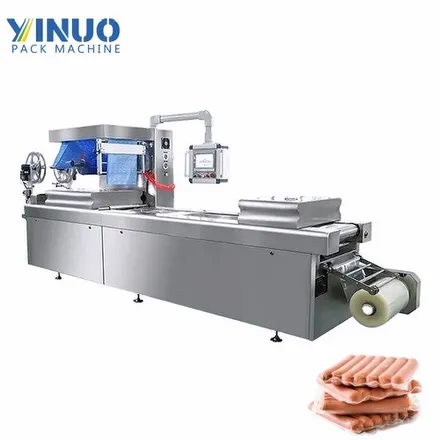
Start with product shape and portion size before choosing equipment
Shape determines how the product enters and moves through the machine
Meat products do not behave like uniform manufactured parts. A steak may have an irregular outline, a chicken breast may vary in thickness, and a sausage may be long, flexible, or curved. These differences affect the feeding, positioning, forming, wrapping, and sealing stages.
- Flat products usually require stable product orientation and accurate positioning before sealing.
- Irregular cuts may need wider conveyors, flexible product guides, or manual loading areas.
- Long products may require extended infeed conveyors and larger forming shoulders.
- Round or cylindrical products may roll, rotate, or become misaligned during transfer.
- Products with protruding bones can damage film, reduce vacuum quality, or create seal contamination.
- Stacked slices require controlled loading to prevent shifting and uneven package thickness.
Portion size affects machine capacity and package dimensions
Portion size is more than product weight. Purchasing teams should record length, width, height, thickness, and weight variation. A machine that can handle the average portion may still fail when it receives the largest portion in the production range.
For example, a 500 gram steak with a narrow thickness range may be suitable for a high-speed automatic line. A 500 gram steak with wide variation in thickness and an irregular bone shape may require slower loading, larger film width, and a more flexible sealing system.
- Small portions can require smaller bags, narrower film, and more precise product spacing.
- Large portions can require deeper chambers, stronger vacuum pumps, and longer sealing bars.
- Thick portions can increase evacuation time and sealing pressure requirements.
- Light portions can reduce productivity if the machine depends on manual counting or weighing.
- Variable portions can make fixed-volume dosing inaccurate.
Purchasing teams must evaluate the full product range
A common buying mistake is testing only the most attractive or most common product. The machine should be evaluated using the smallest, largest, thickest, thinnest, driest, wettest, and most irregular products that will be packaged.
Prepare a product range sheet containing the following information:
- Product name and product category.
- Minimum, average, and maximum weight.
- Minimum, average, and maximum length.
- Minimum, average, and maximum width.
- Minimum, average, and maximum thickness.
- Bone, skin, fat, liquid, and sharp-edge conditions.
- Target package style and package dimensions.
- Required packages per minute or packages per hour.
- Expected operating shifts and annual production volume.
Identify the real purchasing pain points before comparing machines
Throughput targets are often calculated too optimistically
Advertised speed is usually based on ideal product conditions, continuous feeding, standard film, and minimal changeover time. Actual throughput can be lower because of product variation, operator breaks, film replacement, cleaning, inspection, and rejected packages.
Calculate both theoretical and practical output:
- Record the desired finished packages per hour.
- Estimate the number of operating hours per shift.
- Subtract cleaning, changeover, breaks, maintenance, and quality checks.
- Divide the required daily output by the actual production time.
- Add a reasonable capacity reserve for seasonal demand and future growth.
For example, if a factory needs 8,000 packages per day but has only 7 productive hours, the required practical output is approximately 1,143 packages per hour. A machine should not be selected with a rated output of exactly 1,143 packages per hour because product variation and downtime will leave no operating margin.
Seal failure is a major concern for wet and irregular products
Meat juices, fat, bone fragments, wrinkles, and product particles can enter the sealing area. Even a machine with high speed is unsuitable if it produces weak seals, leaks, or damaged film.
Purchasing teams should ask suppliers to demonstrate:
- Seal strength after the product has been compressed or vacuumed.
- Seal performance when moisture is present near the seal area.
- Resistance to puncture from bones and sharp edges.
- Seal consistency at minimum and maximum package thickness.
- Package appearance after transport, stacking, freezing, or cooking.
Changeover time affects labor cost and line flexibility
Meat processors often package several products on the same day. A machine that takes a long time to change film width, sealing temperature, vacuum settings, or product guides can reduce daily output and increase labor costs.
Ask for the complete changeover procedure, not only the time required to change a program. The procedure should include:
- Removing the previous film or bag material.
- Cleaning product-contact parts.
- Changing forming components or guides.
- Adjusting sealing parameters.
- Loading the new film.
- Testing the first packages.
- Approving the new product specification.
Hygiene and maintenance requirements influence long-term cost
Meat processing environments contain moisture, fat, salt, and organic residue. Equipment should support fast cleaning and safe sanitation without creating hidden areas where product can accumulate.
Important design points include:
- Stainless steel construction in exposed and product-contact areas.
- Sloped surfaces that drain water instead of retaining it.
- Tool-free removal of belts, guards, and product guides where practical.
- Protected electrical components and suitable washdown ratings.
- Easy access to vacuum pumps, heaters, sensors, and sealing components.
- Clear cleaning instructions and preventive maintenance schedules.
Follow a step-by-step machine sizing process
First step: define the product and package specification
Write the product specification before contacting equipment suppliers. Do not use general descriptions such as "small meat" or "large steak." Use measurable ranges and photographs showing the most difficult products.
- Measure the minimum and maximum product dimensions.
- Weigh at least 30 representative portions to calculate weight variation.
- Record the amount of liquid, fat, skin, and bone present.
- Define whether the product will be fresh, chilled, frozen, cooked, or marinated.
- Specify whether the package must be vacuumed, gas flushed, skin packed, tray sealed, or simply wrapped.
- Define the required shelf life, storage temperature, and distribution conditions.
Second step: calculate required output and loading method
Determine how many portions must be packaged during the actual production window. Then decide whether the product will be loaded manually, weighed automatically, grouped automatically, or fed through an integrated portioning system.
Use the following calculation:
Required practical speed = required daily packages divided by available production minutes.
Then compare the result with the machine cycle time, number of lanes, number of sealing stations, and expected product loading time. A high-speed packaging machine cannot reach its rated capacity if operators cannot place irregular portions consistently.
Third step: calculate film width, bag length, and sealing area
Product shape directly affects the amount of packaging material required. The film must cover the product without excessive stretching, folding, or unused material. The package must also provide enough seal area for a reliable closure.
Check the following measurements:
- Product length plus the required front and rear seal allowance.
- Product width plus side clearance and forming allowance.
- Product height or thickness at the highest point.
- Film width required for the complete package circumference or tray size.
- Maximum package depth supported by the forming and sealing tools.
- Minimum and maximum film thickness compatible with the machine.
Do not size the machine only for the average portion. Use the largest product and the most demanding package format when confirming chamber depth, forming space, sealing width, and film roll dimensions.
Fourth step: select the suitable machine structure
Choose the machine structure according to product variation, output, package type, and labor availability. Common options include chamber vacuum machines, tray sealing machines, thermoforming machines, flow wrapping machines, vacuum skin packaging machines, and automatic weighing and packing systems.
- Chamber vacuum machines are suitable for bags and products requiring strong air removal.
- Tray sealing machines are suitable for portion presentation, retail packs, and modified atmosphere packaging.
- Thermoforming machines are suitable for continuous production with repeatable product dimensions.
- Flow wrapping machines are suitable for regularly shaped products and high-speed wrapping.
- Vacuum skin packaging machines are suitable for attractive product presentation and extended shelf life.
- Automatic weighing systems are useful when product weight varies and fixed-volume dosing is not accurate.
Fifth step: test the smallest and largest products
Request a factory test using real production materials. Send the supplier the actual product, film, tray, label, and recipe when possible. A test using substitute materials may not reveal puncture, moisture, or sealing problems.
- Run the smallest product at the target speed.
- Run the largest product at the target speed.
- Run the thickest and most irregular products.
- Test products with normal and high surface moisture.
- Test the intended film, tray, bag, or lidding material.
- Inspect package appearance, seal width, seal strength, vacuum level, and product position.
- Measure rejected packages and record the reason for each failure.
- Repeat the test after a product changeover and cleaning cycle.
Sixth step: confirm the complete line interface
The packaging machine must work with the equipment before and after it. Confirm conveyor height, product transfer direction, electrical supply, compressed air, vacuum requirements, drainage, label space, metal detection, checkweighing, carton packing, and data communication.
Request a layout drawing showing:
- Overall machine length, width, and height.
- Operator access and maintenance clearance.
- Product infeed and finished package discharge.
- Film roll loading space.
- Cleaning and drainage areas.
- Connection points for electricity, air, gas, vacuum, and network systems.
Use the right tools to evaluate product and equipment compatibility
Required tools for product measurement
A purchasing team can obtain more reliable machine recommendations by collecting accurate product data. The following tools are useful during product evaluation and factory acceptance testing.
- Calibrated digital scales for portion weight.
- Stainless steel ruler or measuring tape for length and width.
- Digital calipers for thickness and narrow dimensions.
- Camera or smartphone for recording irregular shapes and defects.
- Temperature probe for product temperature.
- Moisture or liquid observation records for wet products.
- Sample trays, bags, films, labels, and cartons used in production.
- Stopwatch for cycle time and changeover measurement.
- Seal inspection tools or a seal strength testing service.
- Data sheets for recording every test result.
Required tools for factory acceptance testing
Factory acceptance testing should measure more than whether the machine turns on. Use a written test plan and document the result of each test.
- Approved product samples from the production line.
- Approved packaging materials from the intended supplier.
- Calibrated scales and dimensional measurement tools.
- Production speed counter or stopwatch.
- Vacuum measurement equipment when applicable.
- Seal inspection equipment.
- Cleaning checklist and sanitation tools.
- Machine parameter records and alarm history.
- Sample labels showing date, batch, weight, and product information.
Use a purchasing comparison worksheet
Compare suppliers using the same criteria. A low purchase price may not represent the lowest total cost if the machine uses excessive film, requires frequent repairs, or cannot handle the full product range.
| Evaluation area |
Questions to record |
| Product range |
Can the machine handle minimum, average, maximum, and irregular portions? |
| Capacity |
What is the verified practical output with real products? |
| Package quality |
Are seals strong, clean, centered, and free from leaks? |
| Changeover |
How many people and how much time are required for a product change? |
| Hygiene |
Can product-contact parts be removed and cleaned efficiently? |
| Utilities |
What are the electrical, air, gas, vacuum, and water requirements? |
| Service |
Are spare parts, training, remote support, and local service available? |
| Total cost |
What are the costs for film, bags, trays, labor, maintenance, and energy? |
Match machine features to shape, weight, and packaging risk
Choose flexible infeed systems for irregular products
Irregular meat products need controlled movement without excessive pressure. Product guides that are too narrow can create blockages, while guides that are too wide can reduce alignment accuracy.
Useful features may include:
- Adjustable side guides.
- Wide and hygienic belt conveyors.
- Low-friction transfer plates.
- Variable-speed infeed control.
- Product spacing sensors.
- Manual loading zones for difficult portions.
- Recipe-based settings for different products.
Use weighing and portion control for variable weights
When portion weight varies significantly, fixed-volume systems may produce underweight or overweight packages. An automatic weighing system can improve giveaway control and support consistent retail labeling.
Confirm the following before selecting a weighing system:
- Target weight and acceptable weight tolerance.
- Minimum and maximum portion weight.
- Number of products combined into one package.
- Product stickiness and transfer behavior.
- Required weighing accuracy at the target speed.
- Integration with printers, labelers, checkweighers, and reject systems.
Use stronger film and protection for bone-in products
Bone-in meat requires special attention because sharp edges can puncture film during loading, vacuuming, transport, and storage. The supplier should recommend suitable film thickness, barrier properties, shrink behavior, and puncture resistance.
Possible solutions include:
- Higher puncture-resistance film.
- Protective bone guard material.
- Rounded product orientation before packaging.
- Reduced vacuum pressure when excessive compression causes damage.
- Larger package clearance around protruding bones.
- Controlled sealing temperature and dwell time.
Use longer sealing cycles for thick and wet products
Thick portions may need more time to remove air from the package. Wet products may require a longer or more controlled sealing process to prevent liquid from entering the seal. Increasing machine speed without confirming sealing performance can create hidden leakage problems.
Optimize these parameters during testing:
- Vacuum time.
- Gas flushing time when applicable.
- Sealing temperature.
- Sealing pressure.
- Sealing dwell time.
- Cooling time.
- Film tension and forming temperature.
Complete a practical installation and commissioning procedure
First step: prepare the production area
Confirm that the installation area is large enough for the machine, operators, cleaning access, raw product movement, finished product flow, and maintenance work.
- Verify floor strength and levelness.
- Confirm electrical voltage and protection requirements.
- Prepare compressed air with suitable pressure and filtration.
- Prepare vacuum, gas, water, drainage, and exhaust connections when required.
- Provide safe access around all moving and heated components.
- Separate raw product flow from finished product flow.
Second step: install and inspect the machine
- Position the machine according to the approved layout.
- Level the machine and secure it according to the supplier instructions.
- Connect power, air, vacuum, gas, water, and network systems.
- Inspect guards, emergency stops, sensors, belts, sealing bars, and film holders.
- Confirm that all food-contact components are clean and correctly installed.
- Run the machine without product to verify movement and safety functions.
Third step: load the product recipe
Create separate recipes for each product shape and portion range. Do not use one general setting for all products if thickness, weight, or moisture conditions are different.
A recipe may include:
- Infeed speed.
- Product spacing.
- Film advance length.
- Forming temperature.
- Vacuum time and pressure.
- Gas flushing volume.
- Sealing temperature and pressure.
- Cooling time.
- Label and coding information.
- Reject limits and checkweigher settings.
Fourth step: run a controlled product trial
- Begin at a low speed with the smallest product.
- Check product orientation, spacing, and package position.
- Inspect the film for stretching, wrinkles, and punctures.
- Inspect the seal for moisture, folds, trapped product, and incomplete closure.
- Increase speed gradually while monitoring package quality.
- Repeat the test with the largest and thickest product.
- Record the highest speed that maintains acceptable quality.
- Perform a leak test and weight check on finished packages.
Fifth step: train operators and maintenance staff
Training should cover normal operation, product changeover, film loading, recipe selection, cleaning, alarm response, and basic maintenance. Operators should understand that incorrect product orientation or excessive product loading can cause machine faults and package defects.
Training records should confirm that staff can:
- Start and stop the machine safely.
- Load film or bags correctly.
- Choose the correct product recipe.
- Adjust permitted operating parameters.
- Identify weak seals, leaks, wrinkles, and punctures.
- Clean and sanitize product-contact areas.
- Respond to common alarms.
- Escalate mechanical, electrical, or quality problems.
Avoid common mistakes when purchasing meat packaging equipment
Mistake one: selecting equipment from average product dimensions only
Average dimensions do not show the full operating range. A machine may work well with average portions but fail with thick, long, heavy, or irregular pieces. Always provide minimum and maximum data and test the worst-case product.
Mistake two: choosing speed before confirming package quality
High speed is not useful if the package leaks, the film tears, or operators must stop the line frequently. Confirm practical output after accounting for loading, cleaning, changeover, inspection, and rejected packages.
Mistake three: using unsuitable film or bags
Film must match the product, machine, package format, sealing temperature, barrier requirement, and distribution conditions. A machine test using a different film may produce misleading results.
Mistake four: ignoring product moisture and fat
Moisture and fat can interfere with sealing and create sanitation problems. Test products under normal production conditions rather than using dry samples or laboratory-prepared portions.
Mistake five: failing to account for bone and sharp edges
Bone-in products need puncture protection and sufficient clearance. If the package is too tight, vacuum pressure or movement during transport may push the bone through the film.
Mistake six: underestimating changeover and cleaning time
A machine that appears productive during a short demonstration may lose capacity during a multi-product shift. Measure the complete changeover, including cleaning, film replacement, adjustment, trial packages, and quality approval.
Mistake seven: overlooking future product development
If the business plans to introduce larger portions, family packs, marinated products, ready-to-cook products, or new retail formats, include these requirements during machine selection. A small additional investment in adjustable tooling or wider working space may prevent an early equipment replacement.
Mistake eight: comparing purchase price instead of total cost of ownership
Evaluate equipment over its expected operating life. Include labor, film waste, energy, maintenance, spare parts, cleaning time, downtime, rejected packages, training, and service response time.
Build a final purchasing checklist for the equipment supplier
Confirm product and package compatibility
- Has the supplier tested the actual product samples?
- Can the machine handle the complete weight and dimension range?
- Can it package products with moisture, fat, skin, and bones?
- Are the proposed film, tray, bag, and label materials approved?
- Does the package meet shelf life and transport requirements?
Confirm performance and capacity
- What is the verified practical output with the actual product?
- What is the expected reject rate?
- What is the complete changeover time?
- What are the utility consumption figures?
- What production data can the control system record?
Confirm hygiene, safety, and service
- Are food-contact parts made from suitable hygienic materials?
- Can operators remove and clean the main product-contact components?
- Are emergency stops and machine guards easy to access?
- What spare parts should be kept on site?
- How quickly can technical support respond?
- Is installation and operator training included?
- Are manuals, electrical drawings, maintenance schedules, and cleaning procedures supplied?
Require acceptance criteria in the purchase contract
Define measurable acceptance criteria before placing the order. These criteria should cover output, package quality, weight accuracy, seal strength, film waste, changeover time, safety functions, and cleaning access.
A clear acceptance test protects both the buyer and the supplier because it establishes the same definition of successful performance. The test should use approved product samples, approved packaging materials, normal operating temperatures, and the agreed production settings.
Choose Meat Packaging Machines that support current and future production
Use product data to make the final decision
The best equipment choice is the machine that consistently handles the complete product range at the required practical speed while maintaining package quality, hygiene, safety, and reasonable operating cost. Product shape and portion size should determine the working area, feeding method, sealing system, film specification, recipe structure, and automation level.
Before making a final decision, complete the product measurement process, run real-material trials, calculate practical capacity, inspect the most difficult products, and review the full cost of ownership. This approach reduces the risk of buying equipment that performs well only in a demonstration environment.
Yijianuo can help purchasing teams evaluate product dimensions, portion variation, packaging materials, production targets, and line integration requirements before selecting Meat Packaging Machines. Contact the technical team with product samples, package specifications, target output, and factory layout information to develop a suitable packaging solution.