Choosing between meat vacuum packaging equipment and a tray-based system affects line speed, film consumption, labor, shelf life, and the amount of capital tied up in packaging inventory. A poultry processor comparing thermoforming vs tray sealing for meat packaging will usually ask whether a best meat packaging machine for high throughput can reduce cost without damaging presentation, while a smaller butcher may focus on tray sealing machine material consumption. The answer depends on the product format, target atmosphere, pack size, and operating schedule. The key engineering terms are the forming web, denesting, and sealing dwell time, while the relevant packaging technologies include MAP packaging, vacuum skin packaging, and barrier film.
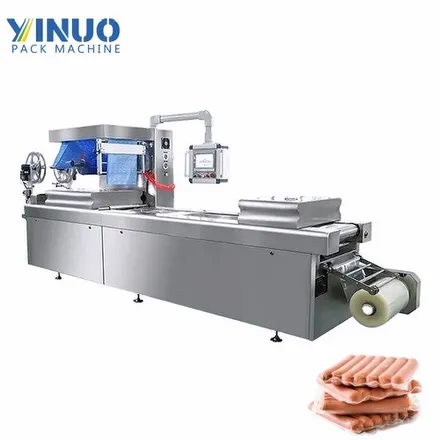
Why Meat Packaging Machines Are Being Compared More Carefully
Processors are under pressure from three directions: rising polymer and cardboard prices, limited skilled labor, and retailers demanding consistent packs with longer display life. A machine that produces 30 packs per minute may appear economical until operators, rejected trays, trim waste, gas consumption, and changeover time are included in the calculation.
Thermoforming and tray sealing are not simply two versions of the same process. A thermoformer creates the lower package from a continuous roll of flexible film, loads the product, applies a top web, and seals or vacuumizes the pack. A tray sealer receives a preformed tray, places or denests it, loads the product, and seals a lidding film over the rim. This difference determines where material is consumed and where line bottlenecks occur.
How Thermoforming Meat Packaging Machines Work
Thermoforming process for vacuum meat packs
- A lower barrier film is heated to its forming temperature.
- A forming station shapes the film into cavities by vacuum, compressed air, mechanical assistance, or a combination of methods.
- Operators or an automatic loader place meat, poultry, seafood, or processed products into the cavities.
- The upper film is applied and the chamber removes air or introduces a modified atmosphere.
- The sealing station bonds the top web to the formed lower web.
- A longitudinal and transverse cutting system separates individual packs.
The main advantage is material integration. The bottom film is both the package and the tray, so there is no separate rigid tray to purchase, store, transport, and feed. A correctly designed forming cavity can also use a narrow web width and minimize the gap between packs.
Where thermoforming equipment performs well
- High-volume sliced meat, bacon, sausage, poultry portions, and boneless cuts.
- Vacuum packs requiring close contact between film and product.
- Retail products with standardized dimensions.
- Plants operating one or more shifts per day with repeatable SKUs.
- Applications where lower packaging weight and reduced tray inventory are priorities.
Indicative industrial thermoforming lines commonly operate at approximately 20 to 60 cycles per minute, depending on cavity count, pack dimensions, vacuum time, loading method, and sealing requirements. A four-cavity machine running at 40 cycles per minute can theoretically produce 160 packs per minute, although actual output is lower after loading interruptions, film changes, sanitation, and quality rejects. A practical OEE range of 65% to 85% is more useful than the nameplate speed.
How Tray Sealing Meat Packaging Machines Work
Tray sealing process for MAP and vacuum skin packaging
- Empty trays are stacked in a magazine.
- A denesting unit separates one tray at a time and places it into the tooling.
- Product is loaded manually or by an automatic dosing or pick-and-place system.
- The machine removes air, adds a controlled gas mixture, or applies a skin film.
- The lidding film is sealed to the tray flange using heat and pressure.
- The sealed tray is discharged for labeling, inspection, and secondary packing.
Tray sealing is attractive because it produces a rigid, familiar retail format. The tray supports delicate portions, gives the package a defined footprint, and can simplify merchandising. It also allows a processor to buy several tray depths and colors without redesigning a forming tool.
Where tray sealing equipment performs well
- Fresh meat and poultry sold in rigid retail trays.
- Products requiring strong visual presentation and stacking stability.
- Mixed product ranges with different tray sizes or depths.
- Facilities that already have a reliable tray supply chain.
- Operations that need quick SKU changes without changing a complete forming set.
Automatic tray sealers often deliver approximately 10 to 30 cycles per minute for standard MAP or vacuum applications. With multiple cavities, output can reach 40 to 120 packs per minute. The actual rate depends heavily on tray denesting reliability, product loading, gas evacuation time, and the required sealing dwell time.
Thermoforming vs Tray Sealing: Throughput and Material Use
| Evaluation factor | Thermoforming | Tray sealing | Operational meaning |
|---|---|---|---|
| Typical line output | Approximately 80–240 packs/minute with multi-cavity systems | Approximately 40–120 packs/minute with multi-cavity systems | Thermoforming usually has the higher ceiling for standardized high-volume packs. |
| Packaging material | Bottom forming film plus top film | Rigid tray plus lidding film | Tray sealing uses an additional structural component. |
| Material utilization | Often 5%–20% web trim, depending on pitch and layout | Tray geometry is fixed; flange and film overlap create additional material | Thermoforming can reduce package weight when cavity design is optimized. |
| Format flexibility | Strong for repeatable dimensions; tooling changes may be required | Strong for multiple tray formats if tooling is available | Tray sealing can be simpler for diverse retail SKUs. |
| Vacuum capability | Well suited to vacuum and vacuum-skin formats | Available, but product and tray geometry can limit air removal | Thermoforming is often preferred for close-contact vacuum packs. |
| MAP suitability | Suitable with gas flushing and compatible films | Very common for rigid retail MAP packs | Tray sealing has a strong installed base in fresh retail meat. |
| Changeover | May require forming and cutting-tool adjustments | Usually requires tray tooling, film, and recipe changes | Changeover time must be measured by SKU, not assumed from machine type. |
| Labor demand | Lower packaging-material handling after automation | Operators or robots must manage tray loading and denesting | Automation level often matters more than the basic machine category. |
| Retail appearance | Lightweight, close-fitting, film-based appearance | Rigid, stackable, familiar tray presentation | Customer expectations may outweigh material savings. |
Material Consumption: Where the Real Savings Come From
Film and tray weight in meat packaging machines
A fair comparison must measure the total package, not only the film roll. Consider a 500 g poultry portion:
- A thermoformed pack may use approximately 10–18 g of lower film and 3–6 g of top film, depending on thickness, cavity depth, and barrier specification.
- A tray-sealed pack may use a 20–35 g rigid tray plus 3–6 g of lidding film.
- The total packaging weight difference may therefore be approximately 10–25 g per pack in favor of thermoforming, although actual results vary by tray design and film gauge.
For 100,000 packs per month, a 15 g packaging-weight difference equals approximately 1,500 kg of material. At a blended packaging-material cost of US$2.00 to US$4.00 per kilogram, the direct material value would be US$3,000 to US$6,000 per month before waste, freight, and disposal costs are included.
These figures are planning examples rather than a guaranteed saving. A thin forming film may require a high-barrier structure, such as PA/PE or PET/PE, and a poorly optimized web layout can increase trim waste. Similarly, a lightweight tray made from recycled PET or polypropylene can narrow the gap. The correct method is to weigh 100 finished packs from each process and record film, tray, trim, rejected packs, and labels separately.
Material-use calculation formula
Use this formula for a plant-level comparison:
Total packaging cost per good pack = (film + tray + trim + labels + gas + rejected-pack material) ÷ number of saleable packs.
For example, if a tray sealer consumes US$0.082 of tray and lidding material and produces a 3% reject rate, the effective material cost is approximately US$0.0845 per good pack before labor. If a thermoformer consumes US$0.061 of film and has a 5% reject rate, its effective material cost is approximately US$0.0642 per good pack. The difference is US$0.0203 per pack, or US$2,030 per 100,000 saleable packs.
Throughput Comparison: Nameplate Speed Versus Saleable Output
Throughput is frequently overstated because suppliers quote cycle speed rather than good packs per hour. A more realistic calculation is:
Good packs per hour = cycles per minute × cavities × 60 × OEE × (1 − reject rate).
Suppose a four-cavity thermoformer runs at 35 cycles per minute, with 75% OEE and a 2% reject rate:
35 × 4 × 60 × 0.75 × 0.98 = 6,174 good packs per hour.
A four-cavity tray sealer running at 22 cycles per minute, with 78% OEE and a 1.5% reject rate, would produce:
22 × 4 × 60 × 0.78 × 0.985 = 4,055 good packs per hour.
The thermoformer produces approximately 52% more saleable packs in this example. However, if the thermoformer requires frequent tooling changes while the tray sealer runs long campaigns, the weekly advantage may be smaller. Production planning should therefore use weekly good-pack output rather than maximum hourly speed.
Scenario Comparison for Meat Packaging Machines
Scenario 1: High-volume poultry processor
A poultry plant producing 6,000 to 10,000 standardized packs per hour generally benefits from thermoforming. The process can reduce tray handling, consolidate packaging inventory, and support automatic loading. The investment is justified when the same pack dimensions run for several hours per shift.
The main risks are higher tooling cost, dependence on consistent product dimensions, and downtime caused by forming-film problems. A product with irregular bone structure or variable thickness may require stronger film and custom cavity geometry.
Scenario 2: Regional butcher with 10 to 20 SKUs
A regional processor producing 1,000 to 3,000 packs per hour may prefer tray sealing. Preformed trays offer predictable presentation, and the machine can accommodate multiple products with different depths. If production is interrupted frequently, a simpler tray-loading workflow may be easier for a small team to manage.
The trade-off is higher recurring material cost and the need to store trays in several sizes. Warehouse space, tray freight, and minimum order quantities should be added to the financial model.
Scenario 3: Premium fresh meat and skin packaging
For premium steaks, bone-in portions, and products where the film must follow the product contour, vacuum skin packaging may be the deciding factor. Both machine categories can support skin formats, but the forming depth, film draw ratio, sealing profile, and product height must be validated in trials.
A rigid tray may offer better merchandising and puncture support, while a thermoformed skin pack may lower material weight. The correct choice depends on shelf-life testing, drip retention, visual quality, and retailer specifications rather than throughput alone.
Scenario 4: Export plant with variable customer requirements
Exporters often need different tray colors, labels, gas recipes, and pack dimensions for different markets. Tray sealing can provide practical flexibility when the tray supplier can deliver the required formats. Thermoforming becomes more attractive when export orders use standardized dimensions and high annual volumes.
Price Analysis: Equipment, Consumables, and Total Cost of Ownership
| Cost category | Thermoforming | Tray sealing |
|---|---|---|
| Initial equipment cost | Usually higher because of forming, vacuum, cutting, and film-control systems | Usually lower for semi-automatic and entry-level automatic models |
| Tooling | Forming molds and cutting tools may cost more per format | Sealing plates and tray tools are required for each major format |
| Consumables | Typically lower package weight per unit | Tray plus lidding film generally increases unit material cost |
| Maintenance | More moving and forming components require trained technicians | Denesting, sealing, gas, and tray-feed systems need regular service |
| Inventory | Mostly film rolls, with fewer rigid components | Requires storage for trays, lidding film, and multiple formats |
| Payback potential | Strong at high volume and long production campaigns | Strong when flexibility and lower capital cost are more important |
As a broad planning range, a basic semi-automatic tray sealer may cost tens of thousands of US dollars, while a fully automatic multi-cavity thermoforming line can move into the low or middle six-figure range after tooling, conveyors, gas systems, loading equipment, inspection, and installation are included. Exact quotations vary by chamber size, automation, materials, certification, and regional service requirements.
For a fair payback calculation, include equipment depreciation, financing, labor, electricity, compressed air, vacuum-pump maintenance, gas, film or tray consumption, sanitation time, spare parts, and rejected product. A machine with a US$100,000 higher purchase price may still be financially preferable if it saves US$0.02 per pack and produces 5 million saleable packs annually. That saving equals US$100,000 per year before other operating benefits.
User Cases and Practical Operating Lessons
An anonymized high-volume poultry case
In a representative poultry-line comparison, a processor handling standardized 450–550 g portions tested a four-cavity thermoformer against a four-cavity tray sealer. The thermoformer achieved approximately 6,000 good packs per hour at 75% OEE, while the tray line achieved approximately 4,000 good packs per hour at 78% OEE. The thermoformed package used about 14 g less packaging material per pack. At 100,000 packs per month, the measured difference was approximately 1.4 tonnes of packaging material.
The tray system still performed better for two irregular products because its rigid container reduced product movement and made manual loading easier. The processor therefore assigned standardized poultry portions to thermoforming and irregular premium cuts to tray sealing. This mixed strategy delivered a better result than replacing every line with one technology.
A small butcher-shop operating case
A smaller meat business running short batches of steaks, minced meat, sausages, and marinated products found that tooling and film changes reduced the expected benefit of thermoforming. A tray sealer allowed operators to switch between two tray sizes with less mechanical adjustment. Although the tray cost per pack was higher, the business valued faster SKU changes, simpler training, and a more familiar retail appearance.
This case illustrates why a high-speed machine is not automatically the most productive choice. If a line spends 25% of its available time changing format or waiting for product, its theoretical cycle rate has limited commercial value.
User Word-of-Mouth Evaluation: What Operators Commonly Notice
Operator feedback tends to focus on practical issues that are not obvious in a brochure:
- Thermoforming feedback: users value lower tray inventory, high output, and close-fitting packs, but they often mention the need for precise film tracking, careful mold cleaning, and consistent product loading.
- Tray-sealing feedback: users value simple retail presentation and format flexibility, but they frequently identify denesting jams, tray shortages, flange contamination, and higher consumable cost as recurring concerns.
- Maintenance feedback: both systems require disciplined sanitation and preventive maintenance. Seal contamination, incorrect temperature, inadequate pressure, and worn gaskets can cause leaks in either format.
- Quality feedback: the most useful acceptance test is a leak test combined with shelf-life and visual inspection, not simply checking whether the seal looks smooth.
When assessing Yijianuo or any other supplier, request references from plants processing a similar product. Ask for measured good packs per hour, average changeover time, film or tray specifications, gas consumption, spare-parts response time, and the percentage of packs passing leak inspection. These data are more reliable than general claims such as “high speed” or “low waste.”
Ranking and Selection Suggestions for Meat Packaging Machines
1. Best for high-volume standardized products: Thermoforming
Choose thermoforming when annual volume is high, product dimensions are consistent, vacuum packaging is important, and material reduction has a measurable financial value. It is usually the strongest option for centralized factories with long production runs and automatic loading potential.
2. Best for flexible retail formats: Tray sealing
Choose tray sealing when product sizes vary, presentation is a priority, multiple tray depths are required, or the operation needs a lower entry investment. It is particularly suitable for regional processors and retailers with frequent SKU changes.
3. Best for mixed production: A hybrid packaging department
A hybrid strategy can be the most objective solution. Use thermoforming for high-volume portions and tray sealing for irregular cuts, premium products, or short runs. This approach avoids forcing one machine to handle incompatible product profiles.
4. Best supplier evaluation approach: Process trial before purchase
Invite suppliers, including Yijianuo, to run the actual product using the intended film, tray, gas recipe, and label. Record cycle rate, good packs per hour, seal strength, oxygen residual, material weight, changeover minutes, and cleaning time. A documented factory acceptance test should form part of the purchase contract.
How to Choose Between Thermoforming and Tray Sealing
- Define the output target: calculate required saleable packs per hour and per shift, not maximum cycles.
- Measure the product range: record dimensions, weight variation, bone content, liquid release, and surface contamination.
- Specify the package function: decide whether you need vacuum, MAP, skin packaging, leak resistance, stackability, or premium presentation.
- Calculate material cost: weigh complete packages and include rejects, trim, trays, labels, and shipping.
- Check labor availability: compare loading, denesting, cleaning, film changes, and inspection requirements.
- Review utilities: confirm electrical load, compressed-air demand, vacuum-pump capacity, and gas supply.
- Test the sanitation process: ask how quickly product-contact areas can be removed, cleaned, and reassembled.
- Verify service support: obtain spare-parts lists, remote-support arrangements, response targets, and technician training details.
Who Should and Should Not Choose Each System?
Thermoforming is suitable for:
- Factories producing more than several thousand standardized packs per hour.
- Processors seeking lower packaging weight per saleable pack.
- Operations with stable product geometry and long production campaigns.
- Businesses able to fund tooling, automation, and technical maintenance.
Thermoforming may not be suitable for:
- Very small businesses with short, irregular production runs.
- Products with extreme height variation or sharp protruding bones unless validated by trials.
- Plants without trained maintenance support or reliable film supply.
Tray sealing is suitable for:
- Retail meat operations needing rigid, stackable presentation.
- Businesses with many SKUs and moderate production volumes.
- Processors that value lower initial investment and familiar tray logistics.
- Products that benefit from additional support against deformation or puncture.
Tray sealing may not be suitable for:
- Very high-volume operations where tray handling limits the line.
- Businesses exposed to tray shortages, high freight costs, or limited storage space.
- Applications where every gram of packaging material has a significant cost or sustainability impact.
Frequently Asked Questions About Meat Packaging Machines
Is thermoforming always faster than tray sealing?
No. Thermoforming often has a higher theoretical ceiling, but actual output depends on cavity count, loading, vacuum time, changeovers, film tracking, and OEE. A well-run tray sealer can outperform a poorly loaded thermoformer.
Which system uses less packaging material?
Thermoforming commonly uses less total packaging material because the lower film forms the package and removes the need for a separate rigid tray. A realistic saving may be 10%–40% by package weight, but the result must be measured using the actual film, tray, cavity, and product specification.
Which method gives better shelf life?
Neither machine automatically guarantees longer shelf life. Shelf life depends on initial microbial load, cold-chain control, oxygen residual, gas mixture, barrier properties, seal integrity, product pH, and storage temperature. MAP packaging and vacuum skin packaging require validation through laboratory and distribution tests.
Is tray sealing easier to operate?
For short production runs, tray sealing can be easier because operators work with preformed trays and familiar formats. Automatic systems still require training in denesting, sealing temperature, pressure, gas settings, and contamination control.
What should be tested before buying a Yijianuo packaging line?
Test the actual meat product with the intended film or tray. Measure good packs per hour, material weight, seal strength, oxygen residual, leak rate, changeover time, cleaning time, noise, and utility consumption. Request a written test report and clarify which performance values are guaranteed.
Can one packaging machine handle fresh meat, frozen meat, and processed products?
Some machines can handle multiple categories, but the tooling, film, temperature, loading method, and sealing recipe may differ. Fresh products with purge, frozen products with sharp edges, and processed products with sauce should be evaluated separately.
Final Recommendation and Next Step
Thermoforming is generally the stronger choice for high-throughput, standardized meat production where a thermoforming machine for vacuum meat packs, high-output meat packaging line, and low-material meat packaging solution can run long campaigns. Tray sealing is generally the safer choice for variable SKUs that need rigid presentation, flexible tray sizes, and a lower initial investment. In the final comparison, measure MAP packaging, vacuum skin packaging, and barrier film performance together with the forming web, denesting, and sealing dwell time. Contact Yijianuo or another qualified supplier with your product dimensions, target packs per hour, film or tray specification, and monthly volume, then request a product trial and a total-cost model before making the purchase decision.