Blog
Sep. 14, 2026
Choosing the wrong packaging configuration can create a chain reaction: excessive purge in the tray, collapsed packs, poor seal integrity, oxygen-sensitive discoloration, film breakage, and rejected products at retail inspection. The problem is rarely the packaging film alone. In most cases, the root cause is a mismatch between the product, gas-removal method, sealing system, tooling, and production speed. That is why Why Vacuum, MAP, and Skin Packaging Need Different Machine Setups is an important question for meat processors, seafood companies, ready-meal manufacturers, and equipment distributors evaluating Meat Packaging Machines.
At Yijianuo, we approach packaging as a process-engineering decision rather than a simple machine purchase. Vacuum packaging, modified atmosphere packaging (MAP), and vacuum skin packaging (VSP) each control air and product presentation in different ways. If one machine is configured to handle all three processes without the correct change parts and controls, the result may be unstable production, inconsistent shelf life, and higher total packaging costs.
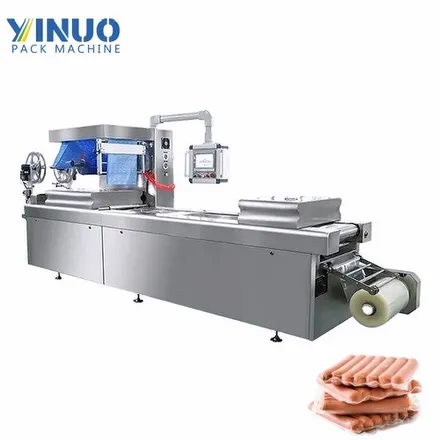
Although all three methods use a tray, lidding film, and sealing station, their operating principles are not the same.
| Packaging method | Main process | Typical pressure or gas requirement | Film behavior | Best suited for |
|---|---|---|---|---|
| Vacuum packaging | Air is evacuated before sealing | Deep vacuum, often below 100 mbar depending on product | Flexible film contracts around the product | Primal cuts, cooked meat, cheese, bulk portions |
| MAP | Air is removed and replaced with a controlled gas mixture | Gas dosing and residual oxygen control | Semi-rigid tray with lidding film | Retail meat, poultry, seafood, ready meals |
| Skin packaging | Product is vacuum-sealed under heated top film | Vacuum plus heat-softened film and controlled forming | Film closely conforms to the product profile | Premium steaks, fillets, high-visibility retail packs |
The distinction matters because a vacuum chamber designed for flexible pouches does not automatically provide the gas-mixing accuracy required for MAP. Likewise, a standard tray sealer may not have the heated forming plate, film preheating, and contour control needed for skin packaging.
In conventional vacuum packaging, the machine extracts air from a pouch or tray before the seal is created. The objective is to reduce oxygen, limit aerobic microbial growth, and protect the product from oxidation and freezer burn.
However, the vacuum level is only one part of the process. Meat products can release liquid, contain irregular bone structures, or trap air in folds. A successful vacuum cycle therefore depends on:
For example, a wet beef cut may require a stronger seal profile and a different dwell time than a dry processed-meat product. If the operator increases vacuum speed without controlling product movement, purge may be drawn into the seal area. This can create channel leaks that are not visible during routine inspection.
Well-designed meat vacuum packaging equipment should allow operators to adjust vacuum time, seal temperature, sealing pressure, and cooling time independently. A recipe-controlled interface is particularly valuable when changing between products with different weights, moisture levels, and film structures.
Modified atmosphere packaging does not simply “remove air.” It replaces the internal atmosphere with a controlled gas mixture, commonly carbon dioxide, nitrogen, and oxygen in product-specific ratios.
The gas formulation depends on the food:
This means a MAP machine needs more than a vacuum pump. It requires:
A typical technical target may be residual oxygen below 0.5–1.0% for selected applications, but the correct specification must be validated against the product, gas recipe, distribution period, and microbiological plan. Operators should not treat a low oxygen reading as a universal guarantee of shelf life.
For MAP operations, meat vacuum packaging equipment must also protect the tray from deformation. Excessive vacuum before gas filling can cause lightweight trays to buckle. Insufficient evacuation, on the other hand, leaves too much oxygen inside the package. This balance is one of the clearest reasons why MAP requires its own machine setup.
Skin packaging uses a heat-softened top film that is drawn tightly over the product and sealed to a rigid tray. Unlike standard MAP, the film follows the contours of the meat, creating a close-fitting presentation with limited product movement.
The machine must coordinate:
The film must soften enough to conform to the product but not become excessively thin at sharp edges. A steak with a protruding bone, for example, requires different film-forming behavior from a flat sliced-meat tray.
A skin-pack system may use a forming plate, plug assist, or controlled differential vacuum. These components are not optional details; they determine whether the film bridges over the product, wrinkles near the perimeter, or punctures at a sharp point.
In practical terms, meat vacuum packaging equipment configured for skin packaging needs a different sealing head, film path, heater arrangement, and tooling geometry from a conventional chamber vacuum machine.
The central cause is that each packaging method controls three variables differently: air, pressure, and film movement.
Vacuum packaging generally emphasizes rapid evacuation and compression. MAP requires a programmed sequence of evacuation, gas injection, stabilization, and sealing. Skin packaging combines vacuum with film forming and controlled contact pressure.
A machine with only one fixed vacuum profile may produce acceptable results for one product but unstable results for another. Yijianuo Meat Packaging Machines should therefore be specified with programmable recipes rather than a single default cycle.
Packaging films vary in:
A high-barrier MAP lidding film is not automatically suitable for skin forming. A flexible vacuum pouch film may seal well in a chamber but cannot provide the controlled contour appearance expected from a skin pack.
Tooling defines tray dimensions, seal geometry, corner radii, product clearance, and film contact. Even a high-quality machine can generate leaks if the tray flange is not supported correctly or if the seal area is contaminated with meat juice.
For this reason, Yijianuo should evaluate:
Precision is especially important in multi-cavity systems. A tooling or registration tolerance controlled to approximately 0.01 mm may be relevant for specific mechanical components, but actual packaging performance must still be confirmed through seal-strength and leak testing.
The quality system should match the packaging process. Useful tests include:
A factory claiming “100% inspection” should define what is inspected. Vision systems can check tray presence, seal-area contamination, label position, and film registration, while leak detection may require sampling or inline non-destructive equipment. A credible acceptance plan should state the sampling frequency, defect criteria, and calibration interval.
Packaging equipment directly influences yield, labor, shelf life, and retail acceptance.
If vacuum is too aggressive, soft products may deform and liquid can migrate toward the seal. If it is too weak, residual oxygen and pack slackness can reduce presentation quality.
Assume a processor runs 20,000 packs per day at a product value of $4 per pack. A 1% packaging-related rejection rate represents:
This calculation excludes labor, film, rework, freight, and retailer penalties. Even a small improvement in seal integrity can therefore justify a more suitable machine configuration.
MAP performance depends on the full cold chain, not only the gas recipe. A poor seal, excessive residual oxygen, incorrect gas ratio, or weak tray can lead to oxidation, discoloration, microbial growth, or package collapse.
For export-oriented businesses, inconsistency can be especially damaging. A shipment may pass factory inspection but fail after long-distance transport if the seal and gas-retention performance were not validated under realistic temperature conditions.
Skin packs often deliver strong visual presentation because the film holds the product in position and exposes more of its surface. They can also reduce purge movement and improve stacking stability.
However, the commercial benefit depends on correct film forming. Wrinkles, bridging, cloudy film, incomplete seals, and punctures undermine the premium appearance. A skin-pack line may therefore require more precise control than a basic tray sealer, but the added control can support higher-value products.
| Machine feature | Vacuum packaging | MAP | Skin packaging |
|---|---|---|---|
| Vacuum pump | Essential | Essential | Essential |
| Gas mixer | Optional | Essential | Usually not the primary function |
| Heated top-film forming | Not normally required | Limited or application-dependent | Essential |
| Programmable vacuum recipe | Recommended | Essential | Essential |
| Residual oxygen testing | Recommended | Essential | Application-dependent |
| Product-height compensation | Limited | Moderate | High |
| Flexible pouch handling | Common | Less common | Not typical |
| Rigid tray tooling | Optional | Essential | Essential |
| Inline vision inspection | Recommended | Recommended | Recommended |
| Seal-leak validation | Essential | Essential | Essential |
The table shows why a universal machine claim should be examined carefully. A platform may support multiple processes, but each process still needs dedicated tooling, recipes, film specifications, and validation procedures.
Before requesting a quotation, we recommend preparing a technical data sheet covering the complete process.
Include:
Specify:
Define:
A responsible supplier should conduct product trials using the customer’s actual trays, films, and meat cuts. We also recommend requesting documented test results rather than relying only on machine photographs or nominal cycle speed.
For higher-risk applications, acceptance testing should include:
A supplier’s technical support should also be measurable. Ask whether the company provides commissioning records, spare-parts lists, operator training, calibration guidance, and a defined service response—for example, remote troubleshooting within 24 hours and an escalation path for critical downtime.
Ignoring the distinction between packaging methods often creates hidden costs before the failure becomes obvious.
Business conditions can also change. A company may begin with bulk vacuum packs and later enter a premium retail channel requiring MAP or skin packaging. If the original equipment has no modular tooling, gas-control architecture, or upgrade path, the business may face a complete line replacement rather than a controlled expansion.
This is why the lowest initial purchase price is not always the lowest total cost of ownership. A machine that saves money at installation but causes 2% additional waste, frequent downtime, or difficult sanitation may be more expensive within the first year.
Vacuum, MAP, and skin packaging are related technologies, but they are not interchangeable operating modes. Their differences in pressure profile, gas management, film behavior, tooling, and quality control require different machine setups.
When we evaluate meat vacuum packaging equipment, we look beyond nominal speed. We consider seal integrity, product variation, film compatibility, sanitation, testing standards, changeover requirements, and future production plans. The same principle applies when selecting MAP tray sealers or skin-pack systems from Yijianuo.
For processors and distributors comparing Meat Packaging Machines, the next step should be a documented product trial and technical specification review. Confirm the correct vacuum system, gas controls, heating zones, tooling, inspection method, and validation standards before placing an order. By selecting the setup that matches the process, businesses can protect product quality, reduce waste, improve shelf-life consistency, and build a packaging line that remains commercially useful as market demands evolve.