For a Cup Filling and Sealing Machine buyer, the choice between pre-cut lids and rollstock film affects more than packaging appearance. It influences material cost, sealing speed, changeover time, product protection, labor requirements, inventory control, and the total return on equipment investment.
Purchasing teams usually want a practical answer to one question: which lid format will produce the lowest total packaging cost while maintaining stable sealing quality and enough flexibility for future products? This guide compares both formats using operating parameters, cost drivers, production experience, advantages, disadvantages, and application recommendations.
Yijianuo provides cup filling and sealing solutions for different production volumes and packaging formats. The correct decision should be based on actual cup sizes, daily output, lid artwork, product characteristics, labor conditions, and the expected growth of the product line.
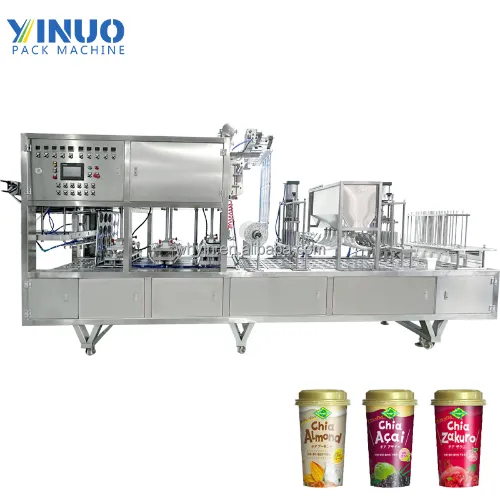
1. Choose the Lid Format According to Total Packaging Cost
Pre-cut lids have a higher material cost but simpler handling
Pre-cut lids are manufactured in advance to match a specified cup diameter and shape. The operator places individual lids or a lid stack into the machine, and the machine applies each lid during the sealing cycle.
- There is no need for an in-line film unwinding system.
- Operators can load printed lids quickly during short production runs.
- There is little trim waste because the lid has already been cut.
- The unit price per lid is usually higher than the material cost of rollstock film.
- Different cup diameters normally require different lid specifications.
- Pre-cut lids require more storage space per finished lid because they cannot be stored as compact rolls.
Rollstock film usually provides a lower cost per sealed cup
Rollstock film is supplied in a continuous roll. The Cup Filling and Sealing Machine unwinds the film, positions it over the cup, seals it, and cuts the lid to the required shape. This process reduces manual lid loading and can lower the cost of packaging material at medium and high production volumes.
- Film rolls are compact and efficient to transport and store.
- Film width and printing can be optimized for the cup diameter.
- Material waste can be controlled through accurate cutting and web tracking.
- The film roll price is often lower per lid than pre-cut material.
- Film tension, registration, cutting, and sealing settings must be adjusted correctly.
- Initial machine investment may be higher because the machine needs unwinding and cutting components.
The correct cost calculation must include hidden operating expenses
A low material price does not always mean a lower total cost. Purchasing teams should calculate the cost per acceptable sealed cup rather than only comparing the price of one lid.
- Calculate the material cost per sealed cup.
- Add film or lid waste caused by setup, misalignment, and rejected seals.
- Add labor for loading, replenishment, inspection, and changeover.
- Add storage and transportation costs.
- Include machine depreciation, maintenance, and spare parts.
- Include the cost of packaging downtime and rejected products.
- Compare the total cost across the expected production volume.
| Cost factor |
Pre-cut lids |
Rollstock film |
| Material price per lid |
Usually higher |
Usually lower at medium and high volumes |
| Initial machine complexity |
Lower |
Higher |
| Manual loading labor |
Higher |
Lower after setup |
| Storage efficiency |
Lower |
Higher |
| Material waste |
Usually low |
Low when web tracking and cutting are properly adjusted |
| Best cost position |
Short runs and many designs |
Stable, repeated, high-volume production |
2. Compare Production Speed and Real Operating Efficiency
Rollstock film is usually better for continuous high-speed production
Rollstock systems are designed for repeated automatic cycles. The film moves through the machine in a controlled web, and the cutting and sealing actions are synchronized with cup positioning. This reduces the need for an operator to place every lid manually.
- Continuous film feeding supports a steady production rhythm.
- Automatic cutting reduces manual lid placement time.
- Film roll replacement can be planned around production breaks.
- Servo or pneumatic systems can maintain consistent film positioning when correctly adjusted.
- The system is suitable for long production runs with the same cup and lid format.
In practical production, the rated machine speed is not the same as the actual output. Actual performance depends on cup feeding, filling accuracy, product viscosity, sealing temperature, film registration, operator skill, cleaning frequency, and the number of rejected cups.
Pre-cut lids can be fast enough for small and medium production lines
Pre-cut lids do not necessarily mean slow production. A well-designed automatic lid magazine can separate and feed lids with limited operator intervention. However, operators may need to replenish the lid stack more frequently, especially when the machine runs continuously.
- Pre-cut lids are easy to load and inspect.
- There is less adjustment during a short production run.
- Operators can change lid artwork without changing a film roll system.
- Frequent lid replenishment can interrupt production.
- Lid stack alignment must be maintained to prevent double feeding or missed lids.
Use effective output instead of nameplate speed for comparison
Purchasers should ask suppliers for effective output based on a complete production cycle. A useful comparison should include filling, sealing, cutting, lid feeding, cleaning, changeover, and quality inspection.
- Rated cycles per minute.
- Actual acceptable cups per minute.
- Average sealing rejection rate.
- Average changeover time between cup sizes.
- Time required to replace film rolls or refill pre-cut lids.
- Percentage of planned production time that the machine is running.
3. Evaluate Flexibility for Cup Sizes, Products, and Artwork
Pre-cut lids offer strong flexibility for multiple designs and short runs
Pre-cut lids are useful when a company sells many flavors, seasonal products, private-label products, or limited-edition designs. Each design can be printed and supplied separately without changing the structure of a continuous film web.
- Suitable for frequent changes between lid artwork.
- Useful for promotional products and small trial batches.
- Easy to manage when different customers require different branding.
- Convenient for products with irregular or specialized lid shapes.
- Suitable when the company does not yet know the final long-term sales volume.
Rollstock film offers better material efficiency for standardized products
Rollstock film is highly flexible when the cup diameter, sealing area, and film structure are standardized. It supports efficient printing, compact storage, and long production runs. However, each new cup format may require a different forming, sealing, or cutting setup.
- Best for one or a few stable cup sizes.
- Efficient for high-volume products with consistent packaging specifications.
- Suitable for printed film with repeated graphics and production planning.
- Can support different film structures for dairy, beverage, dessert, sauce, or snack applications.
- May require more setup time when changing film width, cup diameter, or cutting shape.
Check the practical limits before selecting a format
Purchasers should confirm whether the selected machine can support the required lid diameter, film thickness, sealing layer, cup material, printing registration, and product temperature.
- Cup diameter and height.
- Lid shape, lid edge, and pull-tab requirements.
- Film material, thickness, sealing layer, and barrier performance.
- Product temperature during filling and sealing.
- Product viscosity and the risk of splashing or contamination.
- Required shelf life and oxygen or moisture barrier.
- Number of products and packaging designs planned for the next three years.
4. Compare Machine Operation, Stability, and Maintenance
Pre-cut lid machines are generally easier to operate at the beginning
Pre-cut lid equipment has a relatively direct operating process. The operator loads lids, places cups, sets the sealing temperature and pressure, and checks the finished seal. This can reduce the learning curve for a small factory or a newly established packaging line.
- Fewer film tracking parameters.
- Simple visual inspection of lid position.
- Fast startup for short production tasks.
- Lower dependence on film roll tension settings.
- Easy identification of missing or incorrectly positioned lids.
The main operational risk is lid feeding. Poorly stacked lids, static electricity, damaged edges, or inconsistent lid dimensions can cause double feeding, skewed positioning, or incomplete sealing.
Rollstock machines require more setup but can provide stable long-run operation
Rollstock equipment has more moving and control components, including film unwinding, tension control, web guidance, registration detection, cutting, and waste management. This increases the setup requirements but can produce highly repeatable output once the correct settings are established.
- Film tension must remain stable during the roll diameter change.
- Film registration should be checked when printed graphics must align with the cup.
- Cutting tools must remain sharp and correctly positioned.
- Sealing temperature and pressure must match the film sealing layer.
- Film rolls must be stored in a clean and dry environment.
- Operators need training in web threading and film adjustment.
Battery life is not normally a deciding factor for industrial lid systems
Most industrial Cup Filling and Sealing Machine systems are connected to factory power rather than operated by battery. Therefore, buyers should evaluate electrical stability, control system backup, pneumatic air supply, and restart behavior instead of battery life.
- Confirm the required voltage, phase, and power consumption.
- Check whether the control system retains settings after a power interruption.
- Ask whether the machine can restart safely without damaging cups or film.
- Verify the required compressed air pressure and air quality.
- Check whether film sensors and lid sensors have fault alarms.
- Ask about the expected service life of heaters, sensors, cutting tools, belts, and pneumatic components.
5. Use the Core Parameter Table to Match the Machine to the Factory
Core comparison parameters
| Parameter |
Pre-cut lids |
Rollstock film |
Purchasing implication |
| Feeding method |
Individual lid or lid stack feeding |
Continuous film unwinding and cutting |
Pre-cut lids need more lid replenishment; rollstock needs film threading and tension control |
| Typical production profile |
Short and medium runs |
Medium and long runs |
Match the format to daily production volume and order stability |
| Material cost per cup |
Usually higher |
Usually lower |
Rollstock generally improves unit economics at scale |
| Changeover between designs |
Usually fast |
May require film replacement and web setup |
Pre-cut lids are convenient for many designs |
| Changeover between cup diameters |
Requires a compatible lid and tooling |
Requires compatible film width and machine tooling |
Confirm tooling cost before purchase |
| Operator training |
Lower to moderate |
Moderate to high |
Rollstock requires training in film tracking and cutting |
| Storage volume |
Higher |
Lower |
Rollstock is more efficient when warehouse space is limited |
| Long-run stability |
Good when lid feeding is consistent |
Very good after correct setup |
Inspect feeding stability during a factory acceptance test |
| Design flexibility |
Very high for small quantities |
High for planned repeated designs |
Choose based on product portfolio and artwork frequency |
| Waste risk |
Low material waste, but possible feeding rejects |
Setup and edge trim waste may occur |
Compare total rejected cups, not only material scrap |
| Maintenance focus |
Lid magazine, sensors, sealing head |
Unwinder, rollers, sensors, cutter, sealing head |
Ask for a spare parts list and maintenance schedule |
| Power requirement |
Depends on machine size and automation level |
Usually higher because of additional drive and control components |
Check factory electrical capacity |
Recommended factory acceptance test points
A machine should be tested with the actual cups, lids, film, and product whenever possible. A demonstration using substitute materials may not reveal the real sealing or feeding problems.
- Run the machine for at least one continuous production period.
- Record actual output and acceptable output separately.
- Test startup after a stop and restart.
- Check seal strength after the product reaches its normal storage temperature.
- Inspect leaks, wrinkles, incomplete seals, contamination, and lid misalignment.
- Test all planned cup diameters and lid materials.
- Measure film waste or pre-cut lid rejection.
- Record changeover time between the most frequently used formats.
6. Understand the Actual Use Experience in Daily Production
Daily experience with pre-cut lids
Pre-cut lids often feel easier during the first weeks of operation because the process is visible and intuitive. Operators can see the lid stack, replenish it quickly, and identify a damaged lid before it enters the sealing area.
The main daily inconvenience is replenishment. If the lid magazine is small and the machine operates at a high speed, the operator may need to refill it several times per shift. Frequent manual handling can also introduce dust, fingerprints, or lid deformation if the storage and loading process is not controlled.
- Startup experience: usually simple and fast.
- Short-run experience: very convenient.
- High-volume experience: replenishment may become labor-intensive.
- Stability: depends strongly on lid flatness, stack quality, and feeding alignment.
- Cleaning: generally straightforward because there is no continuous film path.
- Quality control: easy to visually check lid position and surface condition.
Daily experience with rollstock film
Rollstock film usually requires more attention during startup. The operator must install the roll, thread the web through the rollers, align the film, confirm the registration mark, and set the sealing and cutting parameters. Once the settings are correct, the process can run for a long period with limited intervention.
- Startup experience: more technical than pre-cut lid loading.
- Long-run experience: efficient and consistent after setup.
- Changeover experience: depends on film width, artwork, cup size, and machine tooling.
- Stability: strongly influenced by film tension, roll quality, and sensor performance.
- Waste experience: initial setup may create waste until the film is aligned.
- Quality control: requires inspection of seal strength, print position, cutting quality, and film tracking.
Common problems and practical responses
| Problem |
Likely cause with pre-cut lids |
Likely cause with rollstock film |
Practical response |
| Incomplete seal |
Incorrect lid position or warped lid |
Wrong temperature, pressure, dwell time, or film structure |
Check material compatibility and sealing parameters |
| Lid wrinkles |
Damaged or poorly stored lids |
Incorrect film tension or film tracking |
Improve storage and adjust feeding or tension |
| Film or lid contamination |
Manual handling or dirty lid stack |
Dirty film path or product splashing |
Improve cleaning, guarding, and operator procedures |
| Misaligned lid |
Unstable lid magazine or cup positioning |
Incorrect web guide or registration settings |
Inspect sensors, tooling, and cup indexing |
| Frequent stoppage |
Double feeding or missing lid |
Film tracking error, sensor fault, or cutter blockage |
Check sensors and establish preventive maintenance |
7. Summarize the Advantages and Disadvantages of Both Formats
Advantages of pre-cut lids
- Simple operating concept.
- Fast startup for short production orders.
- Convenient for frequent artwork changes.
- Suitable for small factories and product testing.
- Low initial equipment complexity.
- Easy visual inspection of individual lids.
- Useful for irregular lid shapes and specialized packaging.
Disadvantages of pre-cut lids
- Higher material cost per sealed cup in many cases.
- Greater storage volume and warehouse handling.
- More manual replenishment during long production runs.
- Higher labor exposure during lid loading.
- Individual lids can become bent, dusty, or misaligned.
- Different cup sizes and designs require separate lid inventories.
Advantages of rollstock film
- Lower packaging material cost at suitable production volumes.
- Efficient storage and transportation.
- Strong suitability for continuous automatic production.
- Lower manual lid handling after machine setup.
- Good control of printing and material specifications.
- Compatible with long production runs and stable product lines.
- Can improve labor productivity and reduce repetitive loading work.
Disadvantages of rollstock film
- Higher machine complexity and setup requirements.
- More operator training is needed.
- Film roll changes and threading can create downtime.
- Setup waste may occur during alignment and cutting.
- Artwork and cup changes may require more planning.
- Film quality and roll consistency directly affect machine stability.
- Cutters, rollers, sensors, and web guides require regular maintenance.
8. Select the Best Format for Each Purchasing Group
Pre-cut lids are suitable for these users
- Startups validating a new beverage, dairy, dessert, or sauce product.
- Small manufacturers with low or unpredictable daily output.
- Contract packers handling many customers and packaging designs.
- Brands with frequent seasonal campaigns and limited-edition artwork.
- Factories with limited technical staff.
- Products that require unusual lid shapes or special presentation effects.
- Companies that need fast manual material changes between small orders.
Rollstock film is suitable for these users
- Large beverage, dairy, dessert, sauce, and snack producers.
- Factories running the same cup diameter for long periods.
- Companies seeking lower material cost per cup.
- Manufacturers with predictable demand and repeat orders.
- Plants that want to reduce manual lid handling.
- Businesses with sufficient technical staff for setup and maintenance.
- Companies planning to expand production volume over time.
Use a hybrid purchasing strategy when the product range is mixed
Some manufacturers should not force every product into one packaging format. A hybrid strategy can be more economical. Rollstock film can be used for the main high-volume products, while pre-cut lids can be reserved for samples, seasonal products, custom orders, and low-volume designs.
- Use rollstock for stable products with predictable demand.
- Use pre-cut lids for product testing and promotional batches.
- Compare the cost of a second machine against the cost of frequent rollstock changeovers.
- Standardize cup diameters whenever possible.
- Negotiate material supply based on annual volume and design quantity.
Purchasing checklist before placing an order
- Define the current and expected daily production volume.
- List every cup diameter and cup material.
- Identify the number of lid designs used each month.
- Confirm the product temperature and viscosity.
- Specify the required shelf life and barrier performance.
- Request sample sealing tests using actual packaging materials.
- Ask for the real output rate rather than only the maximum rated speed.
- Review power, compressed air, floor space, and operator requirements.
- Request a complete list of wear parts and recommended spare parts.
- Confirm installation, training, warranty, and after-sales service.
Conclusion: Make the Decision Based on Total Cost and Production Reality
Choose pre-cut lids when flexibility and simple operation are the priority
Pre-cut lids are usually the better option for short runs, multiple designs, low or changing demand, and companies that value easy startup over the lowest possible material cost. They can reduce technical complexity and make product changes easier for small production teams.
Choose rollstock film when efficiency and long-run output are the priority
Rollstock film is usually the stronger choice for stable products, repeated cup formats, high daily output, and companies seeking lower packaging cost per cup. It requires more setup discipline, but its continuous feeding method can improve productivity and reduce manual handling.
The best decision is not based on lid price alone. Compare material cost, actual output, rejection rate, labor, changeover time, storage, maintenance, and future product plans. A properly matched Cup Filling and Sealing Machine can make either format effective, while a poorly matched format can create unnecessary downtime and packaging waste.
Yijianuo can help purchasing teams evaluate cup size, filling material, lid format, sealing requirements, and automation level before selecting equipment. By testing the complete production process with real materials, buyers can choose the solution that delivers reliable sealing quality, practical flexibility, and the lowest total operating cost.